
The Social Study of Disappearance Lab
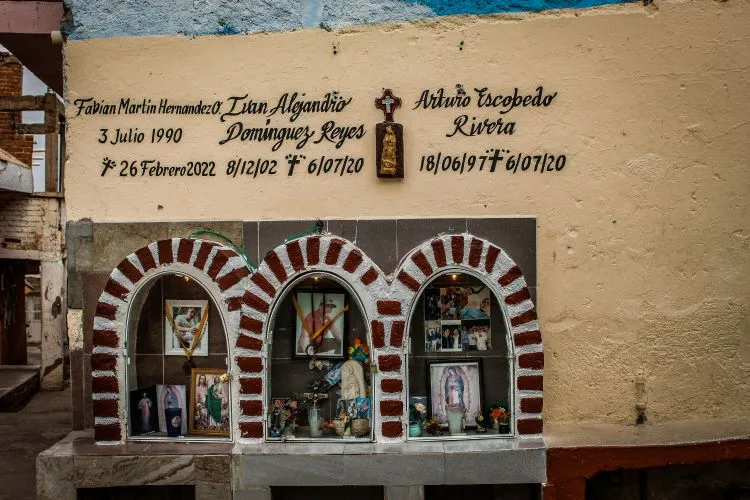
Photo Credit: Fernando Moreno, used with permission
by Maria Beatriz Sabatar Nuñez and Kathryn O'Donovan
Founded in 2023, the Social Study of Disappearance Lab (SSDL) is dedicated to fostering comparative research on forced disappearance.
In the years before the founding of SSDL, Professor Claudio Lomnitz, Anthropology, launched a string of precursor initiatives responding to Mexico’s ongoing disappearance crisis. One was the Buscadoras Research Unit (BRU), which was a volunteer group working with collectives of families of the disappeared in Mexico; the other, a program for engaged pedagogy called the Mexico’s Disappeared Practicum.
It soon became clear that a sustained and structured research effort was necessary to understand both Mexico’s crisis itself and forced disappearance as a contemporary phenomenon. The scale of research required went well beyond what these initial projects could accommodate, prompting the creation of the SSDL to examine how disappearance functions as a form of violence, governance, and control within different global contexts.
Programs
The “Mexico’s Disappeared Practicum” has completed its third year and continues to train students in GIS mapping, digital ethnography, and legal research, equipping them with tools to conduct socially impactful research. This initiative remains a bridge between the work that preceded SSDL’s establishment and the Lab’s current projects.
The “Tertiary Disappearances Project,” created under SSDL, investigates how disappearance data is recorded, manipulated, and miscounted in official statistics.
“The Role of Context Analysis for Memory, Truth, and Justice” working group, also created under SSDL, brings together experts to share their experiences utilizing the juridically-sanctioned procedures of “context analysis” as a tool for justice.
Events
SSDL also serves as a hub for comparative research, fostering collaboration between scholars, journalists, and human rights experts.
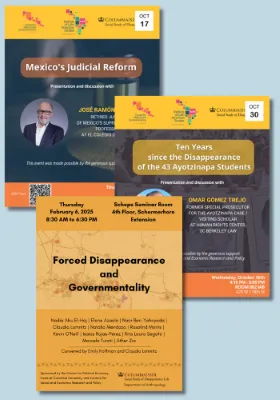
In February, SSDL hosted the conference “Forced Disappearance and Governmentality,” which explored disappearance as a problem for governance across a variety of geographic contexts. Recordings from the conference are available on the Lab’s newly launched YouTube channel.
Last fall, the Lab welcomed Dr. José Ramón Cossío Díaz, former Supreme Court Justice of Mexico, and Edna Jaime, Dean of Social Sciences at Instituto Tecnológico de Monterrey, for a discussion of the implications judicial reform for disappearance. At a separate event, the Lab invited Omar Gómez Trejo, former Special Prosecutor for the Ayotzinapa case, to share insights from his experience investigating one of Mexico’s most infamous mass disappearance cases.
Looking Ahead
SSDL is expanding its programming this spring. On March 28, 2025, the Lab will host “Disappearance in Syria: A Moment of Truth,” a conference examining the search for 136,000 disappeared persons in Syria and the truth-building needed for justice and peace. In April, an exhibition co-curated by Professor Claudio Lomnitz and collaborator Fernando Moreno, En Memoria del Barrio, will open at El Colegio Nacional’s gallery space in Mexico. This exhibition documents the targeted killings of marginalized youth in Zacatecas.
The Lab is also preparing to launch a new initiative next year titled “Thriving Economies Amidst Armed Violence,” a transatlantic research collaboration between scholars in France and the United States that explores the intersections of political economy, governance, and violence. Such initiatives reflect SSDL’s commitment to fostering interdisciplinary research, institutional partnerships, and public engagement.
With the recent launch of its website, SSDL continues to expand its reach as a hub for the study of disappearance. To learn more about its work or attend an upcoming event, visit https://disappearancelab.anthropology.columbia.edu/.