
Identity and International Political Economy Conference
The Identity and International Political Economy Conference asks: How does global economic integration alleviate or magnify identity-based disparities? How do social hierarchies shape support for globalization? And what are the political and economic consequences of these changes?
The cross-border flows of goods and services, people, pollutants and greenhouse gases, and capital have the potential to upend or reinforce the social hierarchies that produce group-based disparities. Yet existing research has paid inadequate theoretical and empirical attention to the processes by which globalization alters group relations and the short- and long-term political consequences of these changes.
This conference aims to introduce cutting-edge scholarship emerging in this domain and foster conversations with scholars who have studied the broader impacts of globalization on domestic political outcomes. Join us for 1.5 days of research presentations, roundtables on theoretical and empirical advances in this domain, and a keynote address by David Lake, Distinguished Professor of the Graduate Division at the University of California, San Diego.
This conference is made possible by the Institute for Social and Economic Research and Policy (ISERP) through its Fellowship program, and organized with Professor Nikhar Gaikwad, recipient of the ISERP Fellowship.
Friday, November 13, 2026
8:15 AM | Check-In, Breakfast and Coffee
8:45 AM | Welcome and Introductions
Nikhar Gaikwad, Columbia University
9:00 AM | PANEL 1: Identity, Trade and Investment
Chair: Allison Carnegie, Columbia University
Presenter 1: Timm Betz, Washington University in St. Louis
The Trade Roots of the Gender Wage Gap (with David Fortunato and Diana O’Brien)
Presenter 2: Benjamin Helms, Texas A&M University
Trade, Consumption, and Political Polarization (with Sonal Pandya and Melle Scholten)
Presenter 3: Ryan Brutger, University of California, Berkeley
Asymmetric or Principled? Racialized Fairness Evaluations in International Economic Policy
10:30 AM | BREAK
10:45 AM | PANEL 2: Identity and Migration
Chair: David Singer, Massachusetts Institute of Technology
Presenter 1: Vicky Fouka, Stanford University
Migration and the Making of the English Middle Class (with Theo Serlin)
Presenter 2: Kolby Hanson, Wesleyan University
Identity and Emigration in Ranked Ethnic Systems (with Nikhar Gaikwad and Aliz Toth)
Presenter 3: Margaret Peters, University of California, Los Angeles
The Price of Dignity: Measuring Migrants' Metaperceptions using Behavioral Games
12:15 PM | LUNCH
1:30 PM | PANEL 3: Identity and Climate
Chair : Alexander Gazmararian, University of Michigan—Ann Arbor
Presenter 1: Sarah Bush, University of Pennsylvania
The Gender Politics of Decarbonization: Evidence from Kuwait
Presenter 2: Gabriele Spilker, University of Konstanz
Disruption, Deservingness and Perceptions of Environmental Protest: Survey Experimental Evidence from Chile and South Africa (with Summer Isaacson, Viktoria Jansesberger, and Sebastian Koos)
Presenter 3: Evan Lieberman, Massachusetts Institute of Technology
Ethnicity and Climate Attitudes in Africa
3:00 PM | BREAK
3:15 PM | PANEL 4: Roundtable on "Identity and IPE: Theoretical Advances"
Panelist 1: Diana Mutz, University of Pennsylvania
Panelist 2 : Kathleen McNamara, Georgetown University
Panelist 3: Thomas Pepinsky, Cornell University
Panelist 4: Nita Rudra, Georgetown University
Panelist 5: Cameron Ballard-Rosa, University of North Carolina at Chapel Hill
4:45 PM | RECEPTION
5:15 PM | Keynote Address
David Lake, University of California, San Diego
Saturday, November 14, 2026
8:30 AM | Breakfast and Coffee
9:00 AM | PANEL 5: Identity and Support for International Cooperation and Aid
Chair: Sonal Pandya, University of Virginia
Presenter 1: Alexandra Guisinger, Temple University
Race, Public Opinion, and Cooperative Friction in International Relations (with Elizabeth Saunders)
Presenter 2: Andy Baker, Purdue University
Racial Paternalism and Support for Foreign Aid: Evidence from the Mauritius Experiment and a Meta-reanalysis (with Lauren Prather)
Presenter 3: Gautam Nair, Harvard Kennedy School
Consumers and Workers in International Economic Policy
10:30 AM | BREAK
10:45 AM | PANEL 6: Roundtable on "Identity and IPE: Empirical and Methodological Advances"
Panelist 1: Eddy Malesky, Duke University
Panelist 2: Leonardo Baccini, McGill University
Panelist 3: Katja Kleinberg, Binghamton University, SUNY
Panelist 4: Ida Bastiaens, Fordham University
Panelist 5: Prerna Singh, Brown University
12:15 PM | Discussion/Debrief
Jack Snyder, Columbia University
12:45 PM | LUNCH
2:00 PM | Conference Adjourns
Motivation
How do processes in the global economy such as integration or decoupling alter inequalities across identity-based groups? What are the societal and political consequences of such changes? When do identity-based divisions in the domestic economy shape incentives for international economic conflict or cooperation? The movement of goods and services, people, pollutants and greenhouse gases, investment, and aid across national borders has the potential to either reify or upturn domestic social hierarchies and group-based inequalities. Yet existing research has paid only limited theoretical and empirical attention to the processes by which the globalization alters group relations and the short- and long-term political consequences of these changes. This conference aims to introduce cutting-edge scholarship in this emerging area of academic inquiry and foster dialogue with scholars who have studied the broader linkages between globalization and domestic politics.
Key Themes and Goals
A motivating theme of research in international political economy is the tradeoffs that emerge when countries join or decouple from the global economy. A vast scholarship examines the winners and losers from globalization, the political strategies that they adopt in response, and the knock-on consequences for political and economic development. To date, however, the scholarship has largely conceptualized and operationalized winners and losers along a somewhat constricted set of economic dimensions, such as wages, skills accumulation, or asset ownership. Yet group-based disparities also manifest along cultural and identity-based lines, including ascriptive dimensions such as gender, race, ethnicity, caste, kinship, religion and linguistic heritage. Globalization holds the potential to upturn many of these identity-based cleavages and inequalities.
How? Why? When? The mechanisms of change remain under-theorized and insufficiently specified. The global economy can alter the economic resources of identity-based groups, empowering some and marginalizing others. This might exacerbate or mitigate existing group-level disparities in access to education, skills accumulation, and capital. Or interdependence can recalibrate the worldviews of communities, fostering change through ideational and normative channels. Contact with “the other” can promote tolerance toward culturally dissimilar groups or may alternately engender prejudice and outgroup anxiety. Separately, changes could flow through political mechanisms, such as the improvement or worsening of governance and the welfare state stemming from external pressures. In addition, exit options can operate as safety valves, increasing the bargaining power of certain groups or hollowing out communities and their political representation.
Perhaps most importantly, general equilibrium outcomes remain least understood, as societies respond to the reshuffling of disparities across cultural groups by altering institutions, laws, and extrajudicial practices (e.g., economic empowerment triggering backlash, leading in turn to group-based violence or institutional changes to limit communities’ political advancement).
Overall, then, the goal of the conference is to advance our understanding of globalization’s consequences for structural inequalities that manifest along cultural dimensions.
The field of international political economy is at an important juncture, with scholars in several domains pursuing exciting research on the linkages between the global economy and identity-related topics, yet with much of the work being developed in silos. Scholarship in this area tends to be domain-specific (e.g., immigration’s impact on intergroup relations, racial cleavages in attitudes toward trade, climate change’s gendered consequences, etc.). Opportunities are being missed for conversations across substantive domains and theoretical advances or empirical/methodological innovations that can translate across issue areas. Insights from different domains and conversations between scholars working both within and outside these spaces hold the potential of stimulating new avenues of research and modes of scholarly inquiry.
Conference Plan
The conference will take place over one-and-a-half days, starting Friday morning, including dinner on Friday night, and ending with lunch on Saturday. The conference is organized around four thematic panels (trade and investment, migration, climate change, and international cooperation and aid) in which scholars will present original research and receive feedback from audience members. The goal is to bring together people who might not normally be in conversation with one another, both to provide feedback and get a sense of how identity is being treated in different areas of the subfield and cognate fields.
The next two panels are structured as roundtables, one on theory and one on empirics, on the broader conference theme. Scholars with expertise in different approaches are participating on the roundtables. Examples of questions that the roundtables might confront include: how can theory be advanced when we consider economic/material explanations juxtaposed with psychological and ideational explanations or when we focus on global approaches vis-à-vis regional or local approaches? Empirically, how can knowledge be accumulated across experimental, macro-historical, qualitative, or large-n studies? A goal of the roundtables is to provide roadmaps for conference participants to think about future research that harnesses the collective wisdom of the group and that responds to existing tensions and debates. The conference will feature a keynote address. Time will be allocated for group reflection and debate.
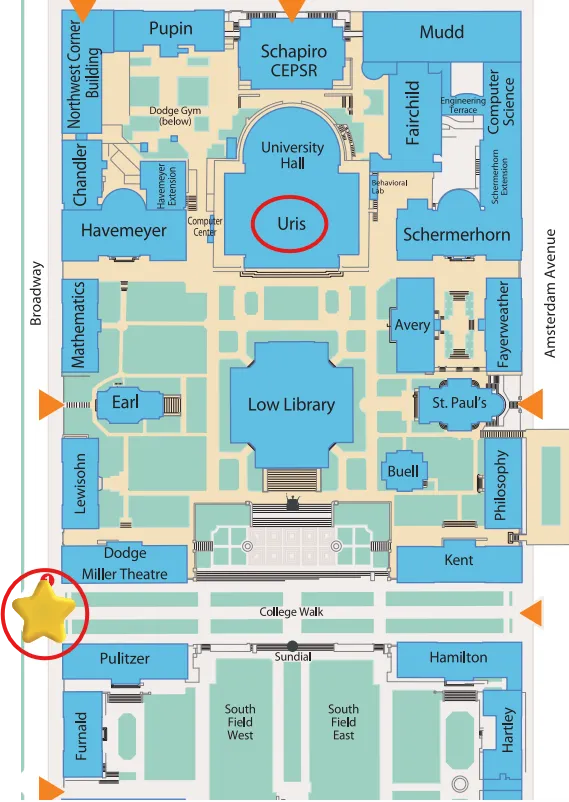
Enter Columbia's campus at the gate on the corner of Broadway and 116th (the star).
Map to Uris:
If you have any questions, please reach out to:
Kathryn O'Donovan, [email protected]