
New Book Forgotten Experts and Grant-Funded Project "GHOST"
Professor Tunç Şen’s recently published book, Forgotten Experts: Astrologers, Science, and Authority in the Ottoman Empire, 1450–1600 (Stanford University Press, 2025), explores the lives and work of early modern Ottoman munajjims—astral experts traditionally translated as “astrologers.” This book grew out of a curiosity about how science operates not only as a body of knowledge, but also as a social practice. His research reveals that munajjims were indispensable intermediaries of knowledge in the Ottoman world, yet they rarely appear in standard narratives of Islamic or early modern science. Recovering their voices required piecing together scattered textual traces—horoscopes, astronomical tables, mathematical treatises, biographical notices, and imperial decrees—from manuscript collections and archives in Turkey and across Europe.
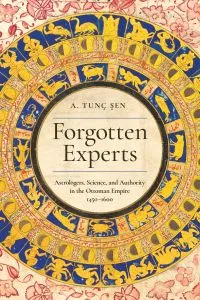
Professor Tunç Şen’s recently published book, Forgotten Experts: Astrologers, Science, and Authority in the Ottoman Empire, 1450–1600 (Stanford University Press, 2025), explores the lives and work of early modern Ottoman munajjims—astral experts traditionally translated as “astrologers.” This book grew out of a curiosity about how science operates not only as a body of knowledge, but also as a social practice. His research reveals that munajjims were indispensable intermediaries of knowledge in the Ottoman world, yet they rarely appear in standard narratives of Islamic or early modern science. Recovering their voices required piecing together scattered textual traces—horoscopes, astronomical tables, mathematical treatises, biographical notices, and imperial decrees—from manuscript collections and archives in Turkey and across Europe.
A key moment of this journey was his involvement as an external collaborator in the European Research Council–funded project Geographies and Histories of the Ottoman Supernatural Tradition (GHOST): Exploring Magic, the Marvelous, and the Strange in Ottoman Mentalities, organized through the Institute for Mediterranean Studies in Crete/Greece, and supported at Columbia by ISERP.
The GHOST project enabled a series of research trips to manuscript libraries and archival sites across Europe—from Istanbul and the Vatican to Malta and England. These trips allowed him to spend sustained time with manuscripts and archival documents he had previously known only through brief engagements. They also led to new discoveries, some of which became integral to the arguments in Forgotten Experts.
Equally important, the GHOST project helped Şen to amass a large corpus of primary sources that now guides his next research endeavor. This forthcoming project examines Islamic manuscripts seized or exchanged during Mediterranean maritime conflicts—captured on ships, traded as war booty, or collected by European humanists. These objects offer a window into the social history of Ottoman subjects who undertook dangerous journeys across the sea, as well as the intellectual history of early modern European (proto-)Orientalists who pursued, preserved, and sometimes misunderstood these texts.
Beyond materials, GHOST fostered an invaluable intellectual community. Working alongside an international group of scholars in Ottoman and Mediterranean studies and the history of science profoundly shaped Şen’s thinking. Their regular workshops and conferences—whether in Crete, Istanbul, or on Zoom—gave him the opportunity to test new ideas in front of a critical yet generous audience. The grant also made it possible for him to present work-in-progress to distinguished audiences at institutions around the world. These opportunities to engage diverse scholarly communities, field questions, and receive constructive criticism were instrumental in refining his book’s narrative arc and analytical framework.
In many ways, Forgotten Experts marks both an end and a beginning. It concludes a long-standing attempt to bring Ottoman astral experts back into the history of early modern science, while opening new questions about the circulation of Islamic manuscripts, the entanglements of warfare and knowledge, and the lived experiences of Ottoman travelers and captives. The GHOST project’s support—channeled through ISERP—was instrumental to this work, not only by funding research trips but by embedding him in a collaborative network that will continue to shape his scholarship for years to come.